It’s been a few years. I’ve been busy with work and family, and unfortunately neglected this website. But beginning today, I am back and plan to begin blogging regularly.
African and ethnic beads have always been a passion of mine, and for that reason I remain committed to this blog. Even to this day there are very few sites committed to the topic, and so I feel all the more encouragement to keep this one going.
If there is anything in specific you’d like me to write about, please let me know.
Tribal jewelry can be difficult to emulate with ‘Western’ beads. Somehow, they just don’t have that same primitive beauty and rusticity you get from beads that have been made by hand. Admittedly, I’ve often overlooked African wood beads in favor of stone and clay varieties, simply because I’ve never appreciated their aesthetic value. But, after a little experimentation, I’ve been inspired. Cheap, lightweight and strikingly beautiful, here are three varieties of African wood beads you can pick up for under ten dollars.
Rosewood Beads
African Rosewood is a beautiful timber characterized by its deep reddish-brown color and dark veining. Being a relatively hard wood, it’s both heavy and durable, making it a popular choice for prayer rosaries and healing bracelets. Genuine African Rosewood has a strong, slightly sweet smell said to relieve nervous tension and migraines. The warm hues of dark rosewood beads work particularly well with brass and copper beads from Ghana.
Kenya Palm Wood Beads
As the name might suggest, Kenya Palm Wood looks markedly similar to the wood of the coconut palm – a light base flecked with darker stripes of color. Kenya Palm Wood Beads are typically darker than most other types of palm wood; the darker hue being more akin to mahogany. Traditionally these beads are often strung with raw Tagua nuts, which are now a common substitute to animal ivory among many tribes.
Olive Wood Beads
With their beautiful dark rings and fine grain, Olive Wood Beads are the perfect focal bead for bohemian jewelry projects. These exquisite wooden beads – which look a little like walnuts – hail from the holy town of Bethlehem, where artisans have been producing them for centuries for Christian rosaries. Olive wood is a hardy, honey-blond wood with a fine grain and smooth finish, making the beads particularly ideal for necklaces and earrings. Olive wood beads are a beautiful accent to recycled glass beads in muted colors, such as sea green and pale blue.
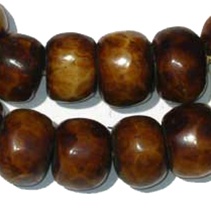
I’m a huge fan of Batik Bone Beads from Ghana. With their two-tone coloration and beautiful hand-painted designs, they can really add to the authenticity of a tribally inspired necklace. Unfortunately, many people are put off using these beads in their jewelry creations owing to misconceptions about the kind of bone used, and how it is sourced. So, I thought I’d use this opportunity to dispel a few myths, and tell you a bit more about where they come from.
1. Bone Beads Are Made From Hunted Animals
Despite legislation prohibiting poaching in many parts of Africa, there are some areas where the illegal hunting of certain species is still a huge problem. However, illegal poaching is more prevalent in places like Kenya – not Ghana. The vast majority of the Krobo and Ashante populations in Ghana are animist in faith, therefore don’t believe in the hunting of animals for personal gain.
2. Animals Are Purposely Killed to Make Bone Beads
As mentioned above, both the Krobo and Ashante tribes are animist in faith, and many also believe that their ancestors are present in all living things. For this reason, they don’t kill animals for sport or pleasure. The cattle bone used to make Bone Beads is sourced from cows and buffalo once they are deceased, so no animals suffer at any stage.
3. Bone Beads Are Made From Man-Made Substitutes
The international bead market is saturated with imitations and replicas from China and India, however, these countries are significantly more advanced (compared to Africa) in terms of the technology needed to produce synthetic beads from plastic, acrylic and porcelain. To this end, when you buy Batik Bone Beads from a genuine African source, you can pretty much guarantee you’re getting the real deal!
I’m no stranger to less-than-honest African bead suppliers. In fact, such are the experiences I’ve had buying trade beads online, I now only buy from one or two reputable sellers. With that in mind, I’ve compiled a few tips to help you choose a bead supplier you can trust – and help you avoid making the same costly mistakes I did!
1. Is Your Supplier An Established Entity?
A trustworthy supplier is omnipresent. They’ve made efforts to improve brand reputation and authority with consistent interactivity with customers on social media sites, and by developing a knowledge center or blog to educate customers. Mentions on multiple well established blogs and forums can also be indicative of how trusted they are by jewelry designers/ collectors.
2. A Website Speaks Volumes
It’s surprisingly easy to distinguish reputable sellers from those looking to make a fast buck by examining their websites. A company looking to establish a reputation long-term will often invest heavily in their website, making it content rich, socially accessible (by linking Twitter and Facebook), and easy to navigate.
3. Are They Forthcoming With Information and Answers?
Many suppliers will attest to having close rapports with bead artists in Ghana and Ethiopia, but are rarely forthcoming about the origins of your beads. This in itself is a red light. Then there are those who profess to sell fair trade beads, but do not supply information about what fair trade initiatives they support or are affiliated with. Look for signs of affiliation, and ask questions before making any purchases. If the company omits to provide answers or information you have requested, chances are their products aren’t what they appear to be.
4. Do They Sell Beads Singly, or By the Strand?
Fledgling suppliers who have relatively few overheads often resell African trade beads singly because they yield a far greater profit than when sold by the strand. At least, that’s the theory. In actual fact, selling at wholesale prices significantly decreases the profit margin of the supplier the more beads are bought (because of wholesale discounts), so it’s actually more profitable to sell them by the strand if they can obtain them in quantitative supply. Access to a vast and constant supply also means its likely the supplier has developed a good rapport with artisans in Africa!
I love using Moroccan Amber Beads in my jewelry, but, there are so many different types on the market, it can sometimes be a little challenging to work out whether or not you’re looking at the real deal. One of the primary causes for confusion is the notion (in some online circles) that copal amber is not real amber. Beads made from copal amber are usually labeled as “Amber Resin Beads”, “Copal Amber Beads”, or simply “Moroccan Amber Beads”. This would suggest, to those who don’t know, that they are probably genuine amber. And they are!
Copal amber, commonly sourced in Morocco and parts of Northern Africa, derives from the same fossilized tree sap as ‘real’ amber, however, is far younger in age. The price margin between the two is a prime indicator of age, as is the existence of inclusions, fossilized insects and fractures. Old amber ranges in color from burnt yellow to jet (caused by significant pressure), whereas copal amber is commonly yellow, orange and sometimes red. You can check whether your beads are made from copal amber by simply applying a little denatured alcohol to the surface with a cotton bud. Copal amber will become sticky, whereas natural old amber will not.
Man-made, or ‘fake’ amber can be made from a variety of materials; most commonly glass, celluloid, casein and plastic. With some varieties, it is possible to discern the difference by looking at them. For example, with plastic ambers, the inclusions are often too big to be genuine; they sometimes have a visible seam, and are often cloudier in color. Amber Beads made from casein and celluloid are a little more difficult to distinguish from the genuine article unless you hold them over a naked flame. Both casein and celluloid will usually give off a plastic smell.
You could also attempt the “hot needle” test. Simply heat a needle over a naked flame and insert into an inconspicuous part of the bead (perhaps around the perforation hole). Real amber will crack when pierced with a hot needle, whereas plastic will not. Genuine amber will also emit a pine-like or sweet scent, whereas man-made amber will give off a conspicuous chemical smell.
Glass Beads have long had their place in Ghanaian culture, but it wasn’t until relatively recently that artisans in the region began producing them in their own right. The glass-making revival began in the 1950s when, faced with the prospect of severe poverty, several artisans among the Asante and Krobo tribes decided to pool their bead-making talents, and begin producing glass beads on a massive scale. These small co-operatives paved the way for a multi-million dollar economy in this small corner of Ghana, which has since become known as the bead-making hub of West Africa.
For me, an inherent part of the appeal of Recycled Glass Beads is their similarity to the Venetian Trade Beads of old. From spotted eye beads popular during the 19th Century, to the more recent White Heart Beads produced in the early 20th Century, the people of Ghana have a knack for reproducing uncanny imitations with relatively basic tools and materials. But, while nearly all beads are made using the old powder-glass casting technique, there are three distinctive styles that set them apart.
Bodom Beads
Bodom Beads are sand-cast beads once produced exclusively for tribal leaders. They are typically larger than most other types of Recycled Glass Beads, and like old Venetian White Hearts, comprise a yellow core enveloped by an outer layer of glass. Bodom Beads usually feature a diamond shape on the outer skin, created by layering glass powder of different colors in a bead mold.
Painted Glass Beads
Otherwise known as Fancy Powder Glass Beads, these are beads which have been skilfully hand-painted to make them look like old Trade Beads. Painted glass beads are typically smoother than plain Recycled Glass Beads because they are tumbled several times when cooled. Traditionally, they would be painted using vegetable dyes, however, most designs are now painted on with colored glass frit. The beads then undergo a second stage of firing to anneal the outer layer.
Translucent Beads
Translucent Recycled Glass Beads are the most common variety produced by the Krobo and Asante. They are often likened to sea glass beads because of their rustic, eroded aesthetics. This is achieved by tumbling the beads in a mix of sand and water to age the outer layer. Genuine Krobo beads are usually two-tone in color, with no visible seam.
With their ripe, juicy colors and fascinating history, Mali Wedding Beads have long been a personal favorite for jewelry making. But, that’s not the only reason these I love these old Trade Beads. An inherent part of their appeal is the tribal symbolism associated with their various shapes – many of which are suggestive of the female form and fertility. If you are considering buying authentic strings of these fascinating beads, it helps to know the kind of shapes and sizes to look out for. Here are some of the most common.
Light bulbs:
A similar shape to the old style of light bulb with a flatt-ish top and straight sides that taper outwards abruptly. The lower portion of the bead is almost perfectly circular, with no visible seam. Light bulbs are among the largest Mali beads, and are prized because of their resemblance to the female form.
Pineapples:
Slightly fatter than a light bulb with a flatt-ish top, graduated sides and a bulbous base. The bulbous part of the bead is slightly elongated, and tapers gently to an almost flat base. Pineapples are wider than most other styles, and can measure between 1 and 1.5 inches.
Claws:
Mali claw beads are easily distinguishable because they look like crab or lobster claws when viewed side-on. The semi-circular shape of the bead is accentuated by a smaller crescent cut out at the rear. Claw beads can either be fat (think ying and yang signs), or elongated, and sometimes have a clipped or straight base.
Teardrops:
Mali teardrop beads are near perfect in shape, with equal length sloped sides and a domed base. The top is usually pointed or domed. Teardrop styles vary in size; they can be long and thin, or short and squat.
Flattened Shapes:
Flattened shapes refer to the squashed ovals and triangles often found on old bead strings. Although not quite as old as some of the more bulbous varieties, they make for excellent focal beads and pendants. Ovals and triangles can range from ½ an inch to 1.5 inches, and are often striped, or multi-colored.
If, like me, you’re always looking for inspiration for that next design project, Mali Wedding Beads sure make for a sound investment. Such is the variety in colors and sizes I get with each string, there are no end of creative possibilities!
According to several independent research studies, as well as reports
African Bone Beads
provided by statistic database Nationmaster; 80% of the ‘top ten’ countries with the highest birthrate in the world (as of 2008) are within Africa. Niger tops the scale with a whopping 49.62 births per 1000 of the population, closely followed by Mali and Uganda in second and third place, with 49.38, and 48.15 births per 1000 respectively. South Africa as a whole bears 20.12 per thousand. When compared with the likes of the United States who average 14.18, and the United Kingdom at 10.65; there is clearly an overwhelming difference – perhaps surprising given how often we hear reports of vast increases in the statistics for teenage pregnancy.
The concurring reasoning for such high birthrates within Africa as a continent, is the lack of contraception available to the populace, particularly within the most impoverished areas such as Niger, Ghana and Ethiopia. Here too, the AIDS epidemic continues to grow, spread and hinder the lifespan of entire generations – all because of a lack of available contraceptives.
Senegal, in the heart of Western Africa represents a country now opening it’s eyes to the issues of mass-breeding , from both a financial and economical perspective. The country may not be as impoverished as Ethiopia, yet there is still widespread poverty on a noticeable scale. Studies still suggest that only 10% of married women within Senegal actually use contraception, despite the increase in availability of both the oral contraceptive pill, and other variants. Many women (even in the ‘developed’ Western world) attest to the contraceptive pill not being the most versatile of family planning tools, largely because it does not provide protection if the user forgets to take it within a 24 hour period.
So what possible answer is there, that will both aid and encourage the women of Senegal to adopt a more sensible approach to family planning? Strangely, it could prove to be a small decorative piece of art, that has been used for adornment and ritual natively, for many hundreds of years – Bone beads! Long favored for their versatility, color and the ease by which they can be polished to a wondrous shine, Bone beads have been used as currency during trade; symbolism/ gifting during rituals and rites of passage, and as personal adornment to ward off evil spirits.
While evidence exists to suggest the women of Senegal have long been using brown and white bone beads, upon a simple strung circle to replicate and keep up with their menstrual cycles, it is Georgetown University of Washington D.C. who have pioneered the ‘CycleBeads’ now being handed out in the country. CycleBead strings comprise of 32 coloured beads upon a circular raffia, each representing a day of the female reproductive cycle. Red dyed bone beads represent the start of menstruation, while the white are significant of the fertile window. Natural brown bone beads indicate when conception would be at it’s unlikeliest.
CycleBeads have not been developed to resolve the contraception issues of Senegal. Rather, they have been designed to educate and encourage women about their fertility and family planning responsibilities. Many women, for religious, or personal reasoning, are still disinclined to adopt the contraceptive pill, and would rather rely upon natural methods of contraception. The aim of these African bone beads is to prompt women to think more logically about their sexual health and family planning. Since 2008, they have been proving to be a slow, but certain success story, and a trend crossing the boundaries into other parts of Africa’s sub-Saharan territories.
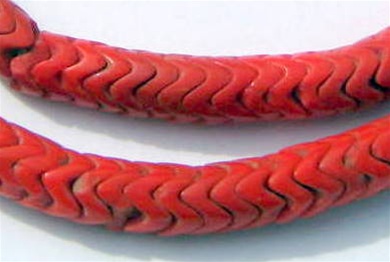
Snake Beads have long been a fascinating variant of African trade bead for
Nigerian Snake Beads, coral color.
jewelry artisans, and collectors. The simplicity of their inter-locking characteristic, coupled with the fascinating hues by which they are now produced have made them versatile for all kinds of modern jewelry – including African waist beads.
The African Snake Beads you see today, are largely reproductions, despite many traders still offering the original Bohemian variants, which can be up to 150 years old. These were made during the height of glass bead production within Czechoslovakia, and are still the most sought after types of Snake Beads on the market.
Czech glass Snake Beads were designed to replicate the actual snake vertebrae of a coiled serpent. Snake vertebrae were used by the indigenous tribes of South Africa for many thousands of years, prior to the capabilities for glass production, and were considered an amulet of protection to many.
Tribes such as the Asanti, Krobo and Yoruba have a significant naturalistic faith; to the extent that they believe spirits accommodate any element of the earth, be it living, mineral or dead. The snake bite tends to be considered a bad omen, particularly since many native African serpents are known to be deadly. The only method by which an individual can be cured of a poisonous bite (according to tribal belief), is if the perpetrating snake is killed; it’s poison mixed with a concoction of hot milk, and a certain bone found within the back of the serpent’s head thrown into the mixture. It is thought application of the bone and mixture to the bite would draw out the poisonous impurities, replacing them with a neutralized substance that would aid healing. Whether this actually worked is subject to speculation, however the Yoruba still wear natural snake vertebrae to discourage venomous attacks, by animals considered to be possessed by negative spirits.
Snake Beads proved to be considerably popular during the 19th Century trade movement between Africa and Europe. Czechoslovakia was fast catching up with Venetian production by this time, although recognized the cost-effective benefits of producing simpler beads with far less decorative attributes. Snake Beads were the obvious option, partly due to the nature of their characteristics, yet also because they were highly prized by the many tribes encountered, during trade trips to Africa. Despite the sliced aesthetic of Snake Beads, they were actually manufactured using the glass molding method – not dissimilar to the manner by which recycled glass beads are made in the Krobo today.
The 1960’s were a time of considerable revival for all manner of trade beads, as Africa began realizing the value of their carefully stashed antiques, and began exporting them in significant quantities. The increase of mass tourism to sub-Saharan areas also commenced a fascination with Snake Beads. The ‘hippie’ era of the late 60’s proved to be a particularly appreciative customer base, as the connecting beads were considered very Bohemian for styles of the time. Jim Morrison is alleged to have been a big fan, and wore a chain of Snake Beads in the Joel Brodsky ‘Young Lion’ photograph (1967).
Today, African Snake Beads are still evidently as popular among ‘Boho’ fashionistas as they were during the 1960’s, however their popularity has been further fueled by celebrity trends. The pop singer Rihanna was photographed in August 2010 upon the cover of ‘Seventeen’ magazine wearing a string of colored Snake Beads. The Snake Bead aesthetic has even borne a replica bead stitch known as ‘tubular Ndebele’, created by tribes within Zimbabwe to simulate the interlocking ‘one-ness’ of Snake Beads. As African and eco-fashions continue to dominate modern trends, it is likely we will be seeing far more of Snake Beads over the next few years.
Persuasive marketing encouraging ‘responsible shopping’ is not a new concept. In fact, the tool has been used for years by charitable and welfare organizations, in a bid to highlight the impoverished conditions many African employees work in, as well as the appalling rates of pay, and even the environmental impact certain processes have upon global warming. No matter where you browse on-line, you cannot fail to have been presented with banner ad’s highlighting such issues. Most of them tend to go ignored.
Responsible Shopping and Africa
What does the ‘responsible shopping’ concept have to do with Africa? Plenty! In fact, you’d be surprised at how just a small minority of people conforming to alternative shopping habits could actually benefit the social, economical and health welfare of the impoverished citizens throughout Africa. Changing your bead shopping habits from a supplier who sources from the Far East, to a supplier who deals directly with African artisans, will put money into the economy, boost the market, and increase interest in the African retail sector. If the incentive of quality workmanship and unique works of art aren’t enough to convince, you could actually be saving a lot of money too!
Changing Your Bead Buying Habits
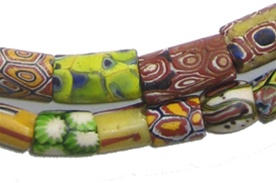
Whether you’re an impulsive collector, or a retailer yourself, changing the
Old Antique Venetian Millefiori African Trade Beads
manner by which you source your African beads will have a direct effect upon the regional African wholesaler that retails them. Such wholesalers are usually employers of many hundreds of bead artisans, all of whom have chosen this particular industry because they are trying to make a better life for themselves. Such wholesalers/ employers tend to be organizations intent on improving the conditions for such people, as well as maintaining a consistent wage for them. Think about it. If you, and ten other people around the world changed your buying habits per day, the African economy would see a considerable boost. It is the organizations within Africa who are trying to get this message across.
Doing Your Research
Part and parcel of becoming a responsible and socially conscious on-line shopper, is an understanding of the source-to-shopper, or supply chain. That is, where your beads come from, who made them, who sells them on, and who benefits from the profits. The really responsible will always ensure there are no ‘middle-men’ when buying their beads. But how do you find out?
The simplest way is to ask. Most online retailers of African trade beads are proud to conform to ethically responsible trading, supporting the regional economies of Africa by sourcing products direct from the producers, and will stipulate this wherever possible on their website. Unfortunately, many do not, so you have to inquire. If your retailer cannot, or refuses to name a specific area, organization or artisan group from which the beads are sourced, this should be enough to prevent you from buying from their site. How do you know the beads are authentic if you don’t know where they came from?
Giving Something Back
The real thrill of responsible shopping, is in the knowing you are giving something back (in terms of sustained and continued support) to a group of individuals, be it within Ghana, Ethiopia or Nigeria, who are actively seeking to improve their conditions, lifestyles and futures. Many consumers are quick to jump on the anti-charity bandwagon, claiming they cannot see where their money is being used, or that they don’t feel it is ‘deserved’ by people less fortunate. By shopping for trade beads responsibly, you are actually helping those who either see bead craft as their last hope, or who want to make a fulfilling and life affirming career from this art.
Big name organizations such as Fashion Fights Poverty, and Beads of Awareness are already increasing the international retail opportunities for the Krobo village tribespeople, along with some of the Ashante living within Kumasi. Both tribes are renowned for their recycled bead production, but also with the production of stunning tribal jewelry, that is now being showcased upon catwalks around the world with Gucci, Prada and Valentino! You too can support such change, by simply adopting a new shopping attitude. Feel good for knowing you’re giving something back!