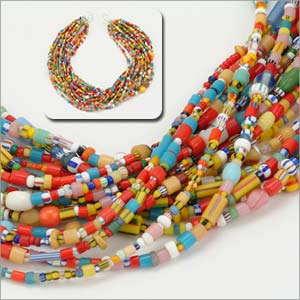
Below is the transcription of a Youtube video I enjoyed which talked about African Kazuri beads in Kenya, and how the industry is doing there. The link to the original video is at the bottom of the post. Enjoy!
——————————————————————-
If there is one thing that women love, it is to be different, to stand out, and to have accessories that place them at the center of attraction. In recent years, the bulk of women’s accessories in Kenya have been beaded necklaces, of all shapes and sizes, colors and designs.
“Kenyans are very fashion conscious, as we know. So whatever is happening in Paris or in New York, they want to be part of it. We are seeing a trend in certain colors and if you look around, you will see contemporary women wearing those. You’ll see a trend towards layering; layering of clothes, different layers, and that’s also reflected in jewelry, and you’ll see women wearing layered clothes, lots of long chains and jewelry. You see that as well, Kenyan’s wearing that. Big earrings, there’s a trend in that. So yeah, people are very switched on.”
Monda African art shop has grown to backup this fashion craze. Carol, our creative director and a trained designer, knows what fashions become more demanding, and consumers become more demanding and sophisticated by the day.
“I got a scholarship to go to Ghana, to study beads, or to study African art, and while I was there they had a lot of heritage of beadwork: they make beads, they wear beads, so that’s where my interest was peaked.”
Silver, gold, and diamonds may still rule the world, but these humble ethnic tastes are timeless, and carry with them, an African story, a target market, and their culture. And designers are making a living out of it.
Dr. Piety Goes (Kazuri Bead Factory): “We saw that Africa is becoming popular, more popular over the past two decades. The change from the old, traditional gold and silver jewelry to new, innovative, new styles jewelry made by some of the brand names in the world. We at Kazuri believe that we are a brand to reckon with.
Kazuri, which means small and beautiful in Swahili, began in 1979 as a tiny rock shop doing handmade beads. Now, it has become a thriving industry that makes the lives of about 300 women. The motto behind this factory was to create employment for single mothers who were in need for regular employment.
Dr. Piety Goes: “At Kazuri here, we actually look at, on improving on the lifestyles of our women. Our mission is actually to employ single mothers of single parenthood who have no income. At the moment we have about 300+ and you can only improve from there. We started with some two people 35 years ago. We are now 300+ as I said earlier, and we can only improve from there. And yes, we can make a difference in the economy but other stakeholders in other industries also need to play their parts to make the economy vibrant.”
Like it is in several small-scale businesses in Africa, the artistic skills are here to fully transform the craftsmen’s lives due to the informal structure of the market as well as exploitation by middle-men.
Roselyne Egosangwa (Ecosandals Limited): “What we do is just deal with our customers direct, because middlemen always exploit the market.”
With this, and the fact that markets abroad offer better returns, companies like Ecosandals, a Kenyan company, have moved online to get in the international market with their leather sandals.
Roselyne Egosangwa: “The present world is a digital world. That is why we decided to go online cause that’s the only way you can reach the far-end market, like the Western and global.”
The beading industry in Kenya has employed women, especially those from the areas with less privilege. It is a craft that doesn’t require skills.
Female Kenyan beading craftswomen: “I have worked here for a long time, managed to take my children to school, as well as buy a piece of land.”
Like any other business, challenges are there in this industry. From high taxation, competition, and even counterfeits.
Carol Monda (Monda African Art Shop): “One would be high tax on imported beads cause for example, the pound beads or what you call Masai beads are imported from Czechoslavakia or from the Czech Republic as well as from India. There’s taxes on that. Leather is taxed, because it’s bead on leather.”
Dr. Piety Goes: “To begin with, the jewelry that’s imported would cost 20% of the products that we sell ourselves. We still need to be competitive. We need to be creative with our colors and designs to be better than the imitation jewelry.”
Treasured by the communities and adored through the years, the bead as an everyday adornment is threatened. All the players hope that the beading culture be kept alive, as it is not only a business venture, but a story of a rich culture that may be threatened by modernization.
Watch the Video